Even raccoons need a landing plan
Ten new transition sets and a movement chart return the focus to what happens between actions.
Retrospective production note. This date follows the production record, rather than the article’s publication.
Published
A surprising amount of paperwork goes into a raccoon landing on its feet.
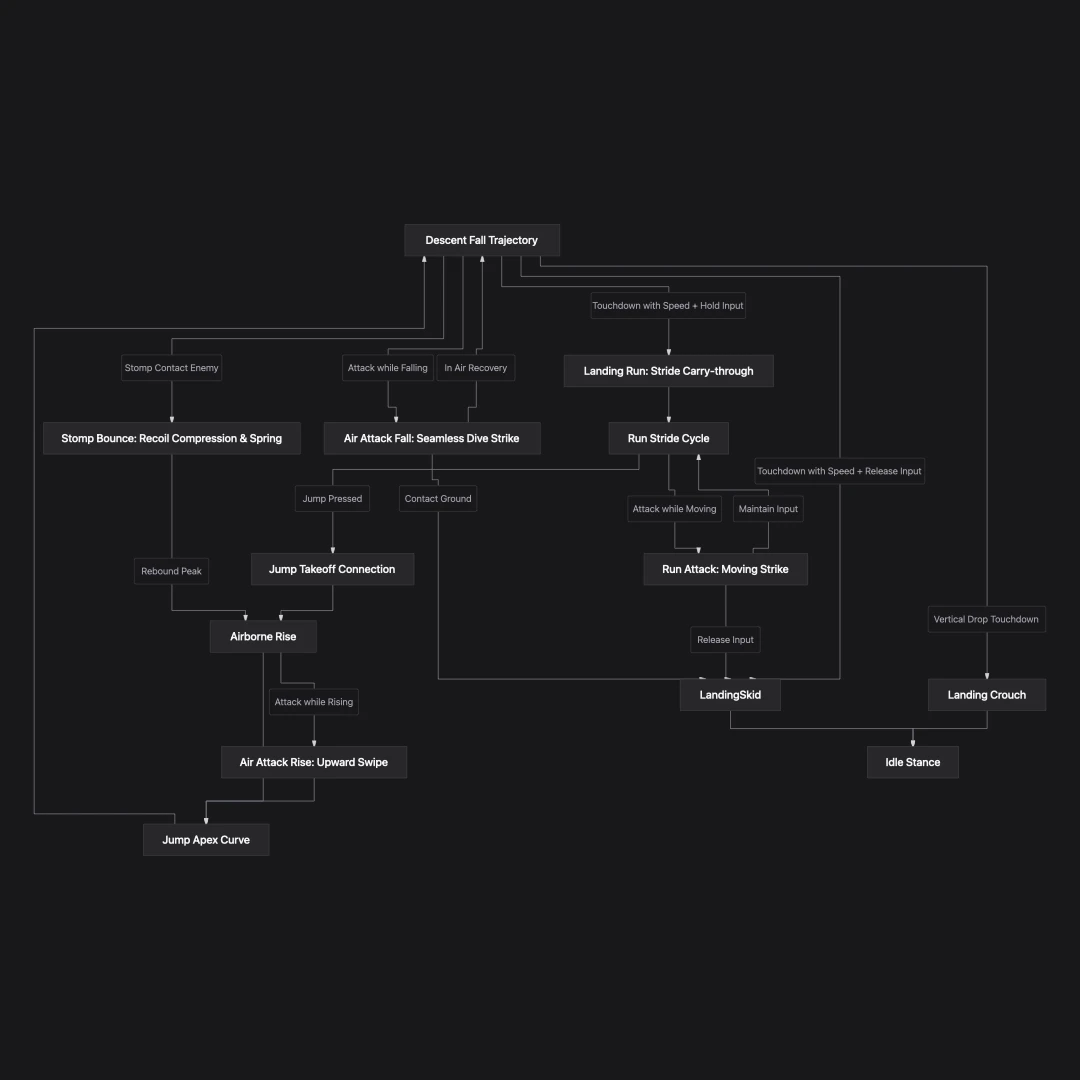
This movement chart follows the connections between actions: running into takeoff, rising through the top of a jump, attacking in the air, bouncing after a stomp, and choosing how a landing resolves.
For this pass, I updated the movement state machine and the presentation layer around those connections, and created ten new handmade animation sets: five for Trashy and five for Jimothy.
Each set needed to match its character’s palette, silhouette, foot registration, and virtual canvas. Changing the pose shouldn’t make the raccoon suddenly shift around inside it.
The hope is less snapping between separate animations and more of a continuous action. That’s an intention, not something a diagram can prove by itself. The next judgment belongs to the movement at normal speed, with real interruptions and repeated jumps.
The earlier transition rollback is part of why this work deserves that test. A tidy arrow between two boxes is a good starting point. The action still has to feel right when a player presses the next button.